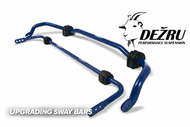
Upgrading Sway Bars
Posted by Dežru Performance Suspension on Feb 11th 2026
Upgrading Sway Bars
What They Do, When They Help, and When They Hurt
Sway bars are one of the most commonly misunderstood suspension components. Many enthusiasts treat them as a simple “stiffer is better” upgrade, but the reality is more nuanced. A sway bar changes how load transfers across an axle, which directly affects balance, grip, and predictability.
Before upgrading, it’s worth understanding what a sway bar actually does and how it interacts with your springs and dampers.
1) What to Know About Sway Bars
A sway bar, also called an anti-roll bar, is a torsion bar that connects the left and right suspension on the same axle. It twists when one wheel moves differently than the other.
- It does not support vehicle weight like a spring
- It only works when left and right suspension move differently
- It mainly influences roll stiffness distribution
- It is a fine-tuning tool, not a primary suspension component
Your main ride quality and grip come from springs and dampers. The sway bar adjusts how the car behaves when cornering.
2) How Sway Bars Function
When you corner, the outside suspension compresses and the inside extends. This difference twists the sway bar.
That twist:
- Resists body roll
- Transfers load from the outside tire to the inside tire
- Changes how each tire is loaded
Because tire grip is load-sensitive, this load transfer directly affects handling balance.
Example:
A stiffer front sway bar often increases understeer. A stiffer rear sway bar often increases rotation and can reduce understeer.
This is why sway bars are used to fine-tune balance rather than add grip.
3) Benefits of Upgraded Sway Bars
Reduced Body Roll
A stiffer bar reduces roll angle in corners and can improve driver confidence and steering response.
Balance Tuning
Sway bars allow you to adjust understeer and oversteer balance without changing springs.
Simple Upgrade
Compared to coilovers, sway bars are relatively affordable, easier to install, and easy to reverse.
4) Drawbacks of Upgraded Sway Bars
Reduced Suspension Independence
Because a sway bar links left and right wheels, it can reduce grip on uneven surfaces and bumpy roads.
Can Mask Poor Suspension Setup
Large sway bars are sometimes used to compensate for springs that are too soft. Proper spring and damper tuning should always come first.
Ride Quality Impact
Bigger bars can increase harshness over one-wheel bumps and reduce comfort in daily driving.
Balance Can Go Too Far
Too much rear bar can lead to snap oversteer. Too much front bar can lead to persistent understeer.
Street vs Track Sway Bar Setup
Street-Focused Setup
- Mild upgrades or stock bars often work well
- Prioritize comfort and compliance
- Too much stiffness can hurt real-world grip
Track-Focused Setup
- Stiffer bars can improve response and balance
- Useful for fine-tuning rotation
- Works best with proper springs, dampers, and alignment
Track cars benefit more from sway bar tuning because surfaces are smoother and consistency matters more than comfort.
5) Conclusion — Should You Upgrade Sway Bars?
It depends on your goals and your current setup.
Consider upgrading if:
- Your springs and dampers are already well matched
- You want to fine-tune handling balance
- The car sees track or spirited driving
Wait if:
- Your suspension is mostly stock
- Comfort is a priority
- You drive on rough roads
The Dežru Perspective:
Sway bars are tuning tools, not magic fixes. They work best when the foundation — springs, damping, alignment, and ride height — is already correct.
Build the foundation first. Then use sway bars to refine the last bit of handling balance.