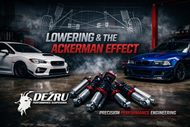
Understanding the Ackerman Effect
Posted by Dežru Performance Suspension on Feb 11th 2026
When you lower a vehicle, you expect changes in center of gravity, body roll, and overall handling. What most people don’t expect is a change in how their front wheels turn relative to each other. This is where the Ackerman effect enters the picture. It is one of the most important steering geometry principles in any vehicle, and it becomes even more critical when modifying suspension height on performance platforms and street cars common among Dežru Suspension customers.
This article breaks down what Ackerman geometry is, why lowering disrupts it, and how to correct the problem for proper steering feel, reduced tire wear, and predictable cornering.
What Is the Ackerman Effect and Why Does It Matter?
When a vehicle turns, the inside tire must follow a tighter turning radius than the outside tire. Because of that, the inside wheel needs to steer at a sharper angle. Ackerman steering geometry is the built-in design that makes this happen. Without it, your front tires fight each other during a turn.
Ackerman helps with:
- smoother low-speed steering
- reduced tire scrub
- better tire life
- more predictable handling
- cleaner corner entry and exit
In a perfect world, if you extend the tie rod lines outward, they intersect at a point near the rear axle. This ensures that during a turn, both front tires are pointing along their correct turning circles.
Most factory vehicles are designed with positive Ackerman for stability and everyday drivability.
Why Lowering Changes Ackerman Geometry
Ackerman geometry is built into the steering arms, rack position, and knuckle design. That part does not change. What does change when you lower a vehicle is the 3D relationship between the steering rack and the steering arms.
Lowered ride height alters:
- Tie rod angle
- Steering rack vertical position relative to the knuckle
- Bump steer curve
- Dynamic toe during suspension travel
When you lower the vehicle, the tie rods angle upward toward the knuckle. This changes the steering arc as the suspension moves through compression and rebound. As a result, real-world steering behavior can drift away from the intended Ackerman curve.
Symptoms of altered Ackerman caused by lowering
Drivers often notice:
- tire scrub in tight turns
- darty or overly sensitive steering
- a nervous feeling mid-corner
- inconsistent response on uneven pavement
- accelerated inner tire wear
- poor return-to-center
- unsettled corner entry at speed
Even if the car feels stable on the highway, incorrect Ackerman during turning can make a lowered vehicle feel twitchy or less confidence-inspiring.
Breaking Down the Root Cause: Tie Rod Geometry
The core issue is that tie rods are no longer aligned with the steering arm plane. Lowering drops the chassis relative to the knuckle, which tilts the tie rods upward. This creates several problems.
1. Changes in the instant center of steering
When the tie rod and steering arm leave their intended plane, the steering arc changes. That can reduce effective Ackerman or introduce anti-Ackerman behavior in tighter turns.
2. Increased bump steer
With the tie rod angled upward, suspension movement adds unintended toe changes. Since both wheels do not change toe equally, the effective Ackerman shifts while cornering.
3. Steering rack offset relative to knuckle
Lowering reduces vertical separation and shifts the original Ackerman intersection point. The knuckle geometry stays the same, but the tie rod path does not.
How to Fix Ackerman Issues After Lowering
There is no single magic cure. The solution comes from restoring tie rod geometry and steering behavior closer to the factory design intent.
Here are practical solutions.
1. Install Roll Center or Tie Rod Correction Kits
These components reposition the outer tie rod pickup to bring angles closer to ideal. This reduces bump steer and helps restore the intended Ackerman curve.
- Mild drops may need only small correction
- More aggressive drops benefit from full correction kits
Dežru Suspension customers with moderate to aggressive drops see significant gains from proper correction.
2. Reposition the Steering Rack (When Possible)
Some performance builds allow rack shimming or repositioning to realign geometry. This is more common in motorsport applications.
Returning the rack toward its intended plane improves dynamic toe control and steering consistency.
3. Use Geometry-Corrected Control Arms
Lowering can shift ball joint and tie rod relationships. Corrected arms restore intended angles and steering response.
They help address:
- tie rod angle mismatch
- roll center displacement
- steering arm misalignment
4. Recalibrate Toe Settings for Lowered Ride Height
Lowered vehicles should not blindly follow factory toe specs since the bump steer curve has changed.
A small, deliberate toe setting matched to use case can stabilize steering feel and tire wear.
Alignment must always be performed at final ride height with full vehicle weight.
5. Choose Suspension Systems Engineered for Lowered Geometry
A properly engineered lowering system considers total geometry, not only spring length. Dežru Suspension coilovers are developed around usable stroke, damping control, and geometry balance.
This includes:
- controlled tie rod angle
- balanced camber gain
- proper droop and compression travel
- optimized damper stroke usage
Using a system designed as a complete package reduces how much correction is needed later.
Conclusion
The Ackerman effect remains one of the most critical steering geometry principles. Lowering changes tie rod angles, rack position, and dynamic toe, which can distort the intended steering curve.
The solution is straightforward:
- restore tie rod alignment
- reduce bump steer
- dial in proper toe
- use geometry-aware components
- select suspension designed for lowered dynamics
Dežru Suspension systems are built with real-world geometry considerations so you gain sharper handling and improved stance without sacrificing steering precision or safety.